9 March, Friday—en route to Okinawa, Japan.

Our last installment ended as we left Brisbane, our final stop in Australia. We had three days until Rabaul, Papua New Guinea.

Amazingly, the sea days go so quickly! If you read the earlier posts on this blog, you can see how many activities there are. We have definitely fallen into a routine. Mornings are breakfast, either in the dining room or the lido, a walk on the deck and lectures beginning at 10 am or a visit to the World Cruise Lounge and chats with friends. The afternoon begins with the Captain's announcements and the blowing of the whistle and ringing the bells. After the Captain's announcement in English, until we reached Sydney, the announcement was translated only into German. Now the announcement is now translated into Japanese. We currently have approximately 500 guests from Japan on board. I love formal night, because so many of the women are dressed in beautiful kimono and look so lovely. We have also seen men in more somber kimono (if that is the correct term for it when worn by a man.) There has been a change in the offering in the Lido also. Breakfast has a large station of miso soup and rice, and lunch has more sushi and Japanese pickled vegetables. We don't eat dinner in the Lido, so I'm not certain about the offerings. Today in the laundry room, I had to help a man who spoke only Japanese use the washer. Through gesture and mime, we got it sorted. He was wearing a beaded pouch for his cruise card around his neck, and it said Crystal Cruises and had the twin seahorse emblem. I said “Crystal Cruises? Number 1!” He broke out in a big grin and said “Number 1! Number 1!”

Our lecturers over the sea days until Rabaul have varied. We have the man, John Hocknull, who served in Papua New Guinea as a District Manager for over 20 years. He was responsible for supervision of villages in the lowlands and deep in the jungle, as well as high in the mountains. His lectures have been interesting, as his duties included policeman, magistrate, jailor and council advisor.

Dr. Maggie Aderin-Pocock, MBE was interviewed by the Entertainment Director, Jo Haley, about space exploration. Richard Atkins spoke again, this time about auto racing and those who he has met. Dr Helen Doe spoke about I K Brunei and his ships. High-Profile Speaker Stephen Cole lectured on “The Tragedy of the Arabs,” A modern look at the history and problems of the Arab World: wars, corruption, terrorism and falling oil prices. A very grim scenario. John Chapman spoke on The Bletchley Park Story—an interesting part of WWII history, but not a great speaker.

We have been treated to current films every afternoon. We've seen “Churchill,” “Three Billboards Outside of Ebbing, Missouri,” “The Weight of Water,” “The Lion,” etc.

The Port Presenter has given excellent lectures on upcoming ports, with much less emphasis on Cunard tours, and more about what we may find independently. A nice touch!

Entertainment still remains weak. We've had Acrobatic Team of Gilles and Laure (since this is the second time they've performed, I wonder if they do odd jobs around the ship like painting the flagpole, etc. Another comedian/singer by the name of Berni Flint performed—pretty old jokes!

We have had guests to the cabin for drinks, and been invited to others. Tomorrow, we will have lunch in The Veranda with three of our friends.

The highlight of this segment was Rabual, Papua New Guinea. This island of 5.9 million inhabitants has had multiple tragedies. It has a long history of occupation and colonization, repeated destructive volcanic eruptions destroying villages and killing and injuring residents. When Japan entered the WWII in December 1941, the Japanese invaded. They turned Rabaul into a fortress and a major supply base for their Pacific fleet. Slave labour was used to dig thousands of miles of tunnels and build airstrips. At its peak, almost 100,000 troops were stationed there and there were five airstrips, submarine and seaplane bases a huge number of naval vessels in Simpson Bay. Rabaul was subject to repeated airstrikes by US warplanes. The town remained in Japanese hands until the end of the war in 1945, but the harbour was littered with over 50 wrecks of ships.

Rabaul was rebuilt, but in 1994, Mt Tavurvur erupted violently, followed closely by Mt Vulcan on the other side of Simpson Harbour. The town was evacuated, but eastern Rabaul was buried under several feet of volcanic ash. All the buildings but one were crushed, because it soon rained and the ash became like concrete, squashing every roof. The only building that remained was the Hotel Rabaul, because the owners and workers continued to shovel off the piling ash. The area around the hotel looks like a wasteland. Rabaul was rebuilt on the other west side, and has developed some industry and increased tourism. Cannibalism was practiced until only about 30 years ago. I was afraid that locals might picture me plump and juicy with an apple in my mouth!

We found the people friendly and gracious. Although English is the official language, there many other languages, because there are 700 different cultural groups. Only 2 per cent are fluent in English. Of note in the photos is the red coloring of the residents teeth and mouths from chewing betel nuts as a mild stimulant.

Housing ranged from very primitive huts to well kept modest homes and larger, more modern home in Kokopo, where the airport is located. There is frequent evidence of war reminders, both in simple museums and as markers in the village: airplane skeletons, etc. Many amazing dive sites are easily accessed throughout the island.

The children are beautiful, many with fair hair, and the mothers are quite deservedly proud of them. We bought a carved hunting mask for our grandsons, made by the man selling them. He was working on one as we watched.

The heat and humidity was perishing, though, and I had turned into a puddle of ghee by the time we returned to the ship.

It was possible to see a glow and smoke from one of the volcanoes as we left the harbour.

We have have three more sea days before arriving in our first port of call in Japan, Okinawa. In addition to Okinawa, we will visit Osaka (overnight and a second one day visit), Kochi, Hiroshima, Kagoshima and Nagasaki. We chose this itinerary primarily because of the return to Japan, and fortunately, all of these ports are new to us. Tucked into this Japanese itinerary is a visit to Busan, South Korea.


Tonight is Neptune's Ball, and only a few of the guests get into the theme evenings, but may attend the balls after dinner. We had a second Crossing of the Equator Ceremony, and this time, our friend Paul was one one of the polliwogs who became a shell back! He was made to kiss a rather large fish, liberally doused in fish parts, spaghetti and colored gook before jumping in the pool! We cross the Equator 4 times in this journey, so we can look forward to more fun!


Sunday, 4th March, 2018 En route to Papua New Guinea

Sunny skies and smooth seas!

I hope I still have some loyal followers of this blog, because it has been too busy to post since we left Bay of Islands.

What can I say about New Zealand: incredibly gorgeous natural scenery, kind people, a diversity of cultures—all things that make it a place to return to. Surprisingly to me, it was a two day sea journey from BOI to Sydney, and a time difference. I really thought New Zealand was closer to Australia than it is. As we crossed the Tasman Sea, the first day was blissfully calm, the second lived up to the title of one of the roughest passages. It is a fairly shallow sea, and when the wind is high, the seas are very rough! I was glad to see Sydney on the horizon and recognize the iconic Sydney Opera House.

Arrival in Sydney found David decidedly under the weather. He had had a cough the day before, but felt OK. However, 27 February when we arrived in Sydney, he had been hit hard, so hard that he agreed to go to the Medical Center, where he was diagnosed with flu—THE flu! He was placed in isolation and given Tamiflu (fantastic drug!) and I was not in isolation, but given Tamiflu to take prophetically to prevent it—one capsule for 10 days instead of 2 for 5 days like David. We had plans to meet our good friends, Terry and Kerry, in Sydney for two days of touring. Of course, David was unable, but I went along. Terry and Kerry were not worried that I would spread it to them, and I suppose the ship's doctor was not either since I was free to go where I wished. I felt badly about leaving David, but all he wanted to do was sleep. I called him every 2 hours, which did not make him happy, but reassured me, and woke him up. I had a lovely day with Terry and Kerry!


Our friends picked me up in front of the Oversea Passenger Terminal—a terrific location at Circular Quay, walking difference to so much! We were really fortunate to dock there, right by The Rocks. Since I had been to Sydney before, Terry planned a trip 2 hours south of Sydney to Illawarra Rain Forest. It was so good to see them and to give hugs all around! We drove South, past the Sydney Airport, which is one of the easiest airports in the world to navigate. We caught up on Terry and Kerry's experience on their crossing from Los Angeles to Sydney on Crystal Serenity on the first segment of the World Cruise. It was great to hear about friends doing the World Cruise and staff and crew onboard.

As we continued south, we saw all the new building of areas stretching far from Sydney. The population of Sydney has grown exponentially as immigration to Australia increases. We drove through the Royal National Park and saw examples of the Australian bush. Terry explained how lightening fires help bring healthy new growth to the bush, and we saw the results of those fires. As we drove further south, we stopped at Bald Hill Headland Reserve—a gathering place for hang gliders, para sailors, and people with motorized flying using a strip of parachute! The setting was a cliff over a gorgeous beach. Wow!! The sky was filled with them! It was hard to tear ourselves away from watching them take off and soar! They made it look so easy! We passed through the charming little town of Thirroul, and then stopped for lunch in another little town, Kiama. I learned that Turkish bread on the menu, is sort of like the bottom half of a piece of panini bread, and I had a cheese and avocado melt on the Turkish bread, which was delicious! It was accompanied by a bowl of fries that we shared, perhaps the best fries I have ever had. Crispy and probably double fried!


Finally, we arrived at the Illawara Rain Forest at Knights Hill. There was the option to zipline or to walk on the tops of the trees on suspension bridges. Can you guess what we opted for? We had the place to ourselves and it was amazing to be 35 meters above the forest floor! The bridges were on cables and there was definite movement as we crossed! Kerry was the only brave one among us to climb up a tower that was 45 meters above the forest floor. The views were stupendous! We saw only birds, but there were signs about snakes on the path. This gave me some trepidation, but the manager assured us that the day was too cold for snakes. We didn't get to see Dozer the wombat, but did see his burrow and his mailbox. It was a great experience! Thank you, Terry, for planning it and hosting me!

We took back roads to a slightly larger town on our way back to Sydney, in order to stop at a Woolworth's (supermarket). As we drove, the road had signs about possible koala sightings and a number to report them. There were also signs about kangaroos, who, evidently, like the open fields from the farms and often appear at dusk.

Purchases in hand, we made our way back to the city and Terry and Kerry dropped me off in front of the cruise terminal with plans for the next day. Unfortunately, David had a very rough night, and neither of us got much sleep. Our plans had been to take a boat up river to another small town, and while I wanted to spend more time with Kerry and Terry, I was worried about leaving David. I emailed Terry about 6 am and sadly canceled our day together. David slept and woke up mid-morning feeling better and ready to “sit up and take nourishment.” He had tea and toast, slept some more and then felt he could eat a small lunch from room service. Meanwhile, the hazmat team from the ship came to clean and sanitize our cabin. They did this three times while David was in isolation. When he napped, I walked literally across the street to the Australian Museum of Contemporary Art. Great venue—and free! Australia believes that everyone should have free access to art. David continued to feel better and better on our second day in Sydney and by the next day, his temperature was normal for 24 hours and he was allowed out of isolation! Thank God for Tamiflu!! Sail away from Sydney was amazing, with the bridge and the Opera House lit up. Good bye, Sydney.

We arrived in Newcastle after only an overnight passage from Sydney. While we went ashore, the hazmat team did a 45 minute deep clean of our cabin. I had no idea what to expect about Newcastle, since it is known as a huge coal distribution area. However, it was a charming, clean and delightful town. It is close to the Hunter Valley wine area and the largest salt water lake in Australia. There are both swimming and surfing beaches, including Ocean Baths, with a fenced off area to prevent interference of Great White Sharks and jellyfish. The town itself is filled with re-purposed vintage buildings, and they have an ethos of preserving the old. We took a shuttle bus into town and were greeted by volunteers, both as we disembarked the ship and at the shuttle site in town. They were very friendly and helpful and handed out very well done, compact guides and maps to the city. Since it was David's first day out, we didn't want to do too much, so elected to take a free bus that ran a 20 minute loop around the town. Fortunately, a lady who lived in the area and who came in to see the Queen Elizabeth berthed, was in the seat in front of us and she gave us a personal guided tour as we drove by the sights. Newcastle has made the most of the sea front, with striking restaurant complexes. Sail way was particularly spectacular. As we sailed by the Fort Scratchly Historic Site, we were saluted with 3 shots (of blanks) by the cannon. The Queen Elizabeth responded by sounding her horn. Hundreds of people lined the causeway out to the fort and waved goodbye to us. It was reminiscent of our amazing sail away in Hamburg on the Queen Mary 2. Tonight's entertainment was comic ventriloquist, Dean Atkinson, who actually was quite funny. Today was also St. David's Day, the patron saint of Wales, and Welsh cakes and singing were offered in the pub.


David was glad that we had a sea day before docking in Brisbane, so he took at easy most of the day. Speakers were Dr. Maggie Aderin-Pocok MBE, a space scientist and science communicator, who spoke, oddly enough, about following our dreams. The other speaker was Richard Atkins, who spoke on “Fast Ladies in a Man's World—Lady Race Drivers 1900-1939. Trivia Team, A Wing and a Prayer, now has two more members to bring our team up to 6. Michael, a chef and his wife, Pat, a hotel manager from the UK have joined our team. We came in third today. A highlight of today was the showing of the film “Three Billboards Outside Ebbing, Missouri.” It's an excellent film and, hopefully, will garner lots of awards at the Academy Awards.

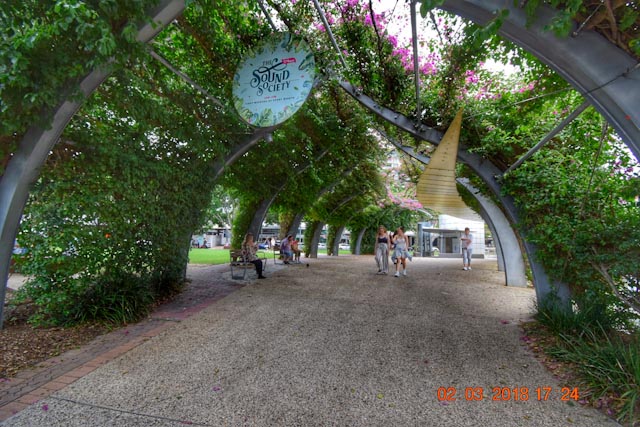
Saturday, 3rd March, we docked in Brisbane, at the Port of Brisbane, about 45 minutes outside of town. Cunard offered shuttles between the ship and the Anzac Memorial in the city center. We took a fairly early shuttle into town, and walked south on Queen Street with the goal of getting on a ferry. Brisbane has several ferry systems that traverse the river, one of which, the City Hopper, offers a free loop. Queen's Street and the Queen's Street Mall are one store after another, and all the big name brands are represented: Gucci, Louis Vuitton, Tiffany, Hermes, etc. In the pedestrian street, the Queensland Symphony Orchestra was performing! As we headed to the river, we were treated to a parade in honor of the Chinese New Year. Groups representative of all the Chinese social and service organizations in Brisbane marched in colorful native outfits. What a treat! We left the parade at its end and walked down the riverbank to the river and the ferry dock. After about a 10 minute wait, the City Hopper pulled in and we were able to get seats on the back deck. At the next stop, lots left the ferry and we were able to move up to the top deck, which was sheltered under an awning, just in time to be protected from the rain that began. Brisbane certain knows how to make the most of its riverfront. In addition to the South Bank Parkland, which we later visited, there are recreation area, parks, apartment complexes and dining venues lining the banks. We took the ferry back to the South Bank Parkland, and were dropped off at the bottom end. The last time we were in Brisbane, I had seen the Bougainvillea Arches that extended for one kilometer within the park. Before we got to the beginning of the arches, we past a beach in the middle of the city and paddling pools created out of rock, so that it looked like a natural pool.. There was a Saturday market set up, and many restaurants, bars and fast food places, not our favorite part. We walked under the arbors, but, unfortunately, the bougainvillea were not in full bloom, so there was just a smattering of them. The Queensland Performing Arts Center was at the end of the arbors, and several museums are located here, too. We ubered over to the other side of the river to our favorite store, Woolworth's, to replenish our supply of bottled water, and then walked several blocks to the Anzac Memorial again to pick up the shuttle bus back to the ship. Unfortunately, they had to re position the gangways, so our arrival onboard was delayed about an hour. We were glad to get back on board, because even though we thoroughly enjoyed Brisbane, it was about 90 degrees and very, very humid!!


After showers and shampoos, we felt human again. Tonight was the Australian Ball, so we took our new friend “Skippy” to drinks and dinner. Skippy is an inflatable kangaroo, about 4 feet tall. He garnered second takes and lots of smiles and comments. We were going to wear our Australian hats with the dangling corks to keep away the flies, but hats are not allowed in the dining room, so Skippy came instead. (Thank you, Terry and Kerry!!!) Skippy had a seat of his own at the head of the table and many people came over to chuckle. Our wine Steward brought him several empty glasses of wine, and many people came by the table to chuckle or give him a hug. His name “Skippy,” courtesy of our dear friend Lin, came from the children's TV series in the 1950's “Skippy the Bush Kangaroo.” Evidently, it was very similar to the US series “Lassie,” with the same ability of the animal to communicate with humans: “What, Lassie? Timmy's stuck in the well???” and “What Skippy, Timmy's stuck in the well???”

This morning we are on our way to Rabaul, Papua New Guinea. This will be our first visit at this port, on the second largest island in the world—second only to Greenland. Cannibalism only officially ended several years ago, and I'm afraid I will look like a plump, tasty meal to them! This is the only port on our journey where malaria is endemic. For this reason, we must begin taking Malarone as protection against Malaria two days before we arrive and 10 days after. I went to a lecture on Papua New Guinea, by John Hocknull, who worked for the Australian government as a sort of manager in the undeveloped area of Papua New Guinea in the 1970's and 80's. The talk was interrupted by the Captain announcing that we have changed course and were now heading closer to land, because we are to have a helicopter evacuation in about 3-4 hours. That should be happening soon. They are removing all the chairs from the aft pool deck and clearing the area of any guests. Our thoughts and prayers are for the person whose condition is so urgent to require this evacuation.

We will be heading to Trivia soon, so stay tuned!